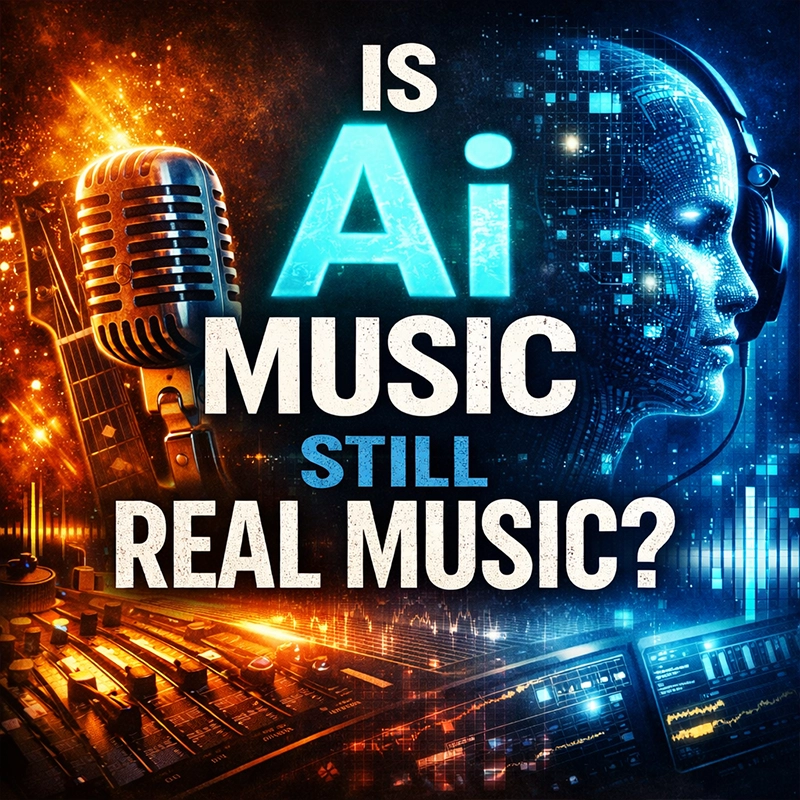
IS Ai MUSIC STILL REAL MUSIC?
WHILLY BERMUDEZ
Yes — and the Argument Isn’t as Deep as People Think
Introduction: Let’s Not Pretend This Is Complicated
The question keeps coming up:
“Is Ai music real music?”
“Is someone who uses Ai vocals a real artist?”
Short answer: Yes.
Long answer: Yes — and this debate is mostly unnecessary.
Music has always evolved through tools. Ai is not a replacement for creativity — it’s another instrument. And like every instrument ever invented, it can be used well or poorly.
Let’s not get into the silliness of it all.
Because at the end of the day, good music is still good music, no matter how it’s made.
1. The Wrong Question Is Being Asked
People keep asking:
“Is Ai music real?”
That’s the wrong question.
The real question is:
Does it require creativity, intention, and decision-making?
And the answer is obviously yes.
Ai does not:
- Decide what story to tell
- Choose emotional direction
- Write meaningful lyrics on its own
- Understand cultural context
- Know when something feels right
That part still belongs to the human.
2. Ai Is a Tool — Not a Mind
Ai doesn’t wake up inspired.
It doesn’t feel heartbreak.
It doesn’t understand loss, joy, nostalgia, or fear.
It responds to human input.
That input includes:
- Lyrics
- Mood
- Genre
- Structure
- Direction
- Taste
- Editing decisions
- What stays and what gets deleted
Calling Ai the “artist” is like calling a piano the songwriter.
3. The DJ Argument Ends the Debate Immediately
Here’s the simplest comparison — and it matters:
Is a DJ who mixes other people’s music an artist?
Of course they are.
They:
- Select
- Curate
- Arrange
- Transition
- Build energy
- Control emotion
They don’t sing.
They don’t play instruments.
They don’t write melodies.
Yet no serious person says:
“That’s not real music.”
So why does the argument suddenly change with Ai vocals?
It doesn’t hold up.
4. Tools Have Always Been Part of Music
Every generation draws an imaginary line and says:
“This is where music stops being real.”
They said it about:
- Electric guitars
- Synthesizers
- Drum machines
- Auto-Tune
- DAWs
- Sampling
- Loop-based production
And every time, music moved forward anyway.
Ai is just the latest tool — not the first, and not the last.
5. Using Ai Does Not Mean Zero Effort
This is one of the biggest misconceptions.
People assume:
“Ai makes everything for you.”
That’s only true if the result is bad.
Good Ai-assisted music still requires:
- Strong lyrics
- Clear vision
- Iteration
- Editing
- Rejection of weak outputs
- Musical judgment
- A trained ear
Anyone who’s actually used Ai tools knows:
Most outputs are unusable without human refinement.
Effort didn’t disappear — it shifted.
6. Lyrics Still Separate the Real From the Fake
Ai doesn’t save weak writing.
Bad lyrics are still bad.
Empty lines still sound empty.
Random words still feel random.
Great lyrics still matter more than:
- Vocal tone
- Production tricks
- Technology used
If a song hits, it’s because:
- The words mean something
- The story makes sense
- The emotion is believable
Ai cannot fake that on its own.
7. Direction Is What Makes Music Real
Real music has direction.
Someone decides:
- Where the song starts
- Where it goes
- What it’s about
- What emotion it lands on
Ai doesn’t choose direction.
It follows it.
That’s the difference.
8. The “Authenticity” Argument Is Mostly Fear
Let’s be honest.
A lot of resistance to Ai music isn’t philosophical — it’s emotional.
It’s fear of:
- Being replaced
- Losing relevance
- Not understanding new tools
- The industry changing (again)
That’s human.
But it’s not a valid definition of art.
Authenticity isn’t about how something is made.
It’s about why.
9. If the Song Is Good, the Song Is Good
Listeners don’t ask:
- What DAW was used
- What plugin was involved
- Whether vocals were synthesized
- Whether drums were programmed
They ask:
“Do I feel something?”
That’s it.
Music has never required a disclosure label to be real.
10. Bad Ai Music Exists — So Does Bad Everything Else
Yes, there is terrible Ai music.
There is also:
- Terrible guitar playing
- Terrible singing
- Terrible songwriting
- Terrible production
The existence of bad work does not invalidate the medium.
It just exposes who hasn’t developed taste yet.
11. Taste Is Still the Ultimate Skill
Ai doesn’t replace taste.
It exposes it.
Two people can use the same tools.
One creates something meaningful.
The other creates noise.
That difference is human.
12. Effort Is Not Defined by Physical Labor
Some people confuse effort with:
- Playing instruments
- Singing vocals
- Performing live
But effort also includes:
- Conceptual thinking
- Editing
- Refinement
- Emotional honesty
- Restraint
Effort isn’t always visible — but it’s always present in good work.
13. Music Has Never Been a Moral Test
Music is not a purity contest.
There is no moral high ground in:
- Avoiding tools
- Rejecting technology
- Doing things “the old way”
There is only:
- Does it work?
- Does it connect?
- Does it last?
14. Ai Doesn’t Eliminate Artists — It Reveals Them
When tools become powerful, the gap widens.
Those with:
- Vision
- Discipline
- Taste
- Emotional intelligence
Stand out more.
Those without it get exposed faster.
That’s not a threat — that’s clarity.
Final Thoughts: Let’s Move On
Yes — Ai music is real music.
Because:
- Creativity is still required
- Direction still matters
- Lyrics still matter
- Taste still matters
- Effort still matters
The rest is noise.
Music has always belonged to the people who care enough to shape it — not the tools they use.
And that hasn’t changed.